
On this week’s episode of TMOAMM (Episode 4), you’ll experience a different voice, because this a guest post.
I’m SeBian or Tsardav depending on who you’re asking, and I’m a mad man, but then… is there anyone in this country who isn’t mad? Nope, we all are!
When Morolake asked me to guest blog on her website, I was very reluctant to do so. That’s because I’m quite discouraged when it comes to putting my thoughts into writing. However, since this is a data-based post and the topic is one that I have always bemoaned, I might as well just put it out there that “Bribery and Corruption has killed us and is plundering our graves”.


The above illustration clearly describes how corruption has outgrown us and is making us pay for grooming it. But, just how deep is this corruption you may ask?… Let’s consider three scenarios.
SCENARIO ONE.
“We will get back to you sir”, said Mr Rohr. “You better”, Mr Adamu replied, “time is going, if you don’t and someone else does, we’ll give them audience instead”. The representatives from ElixirBioTech just submitted a proposal to a high ranking member of the ministry of technology. They’re proposing to build an 8million dollar bioenergy plant in the heart of Minna in Niger state, but they had just been rebuffed by Mr Adamu who had requested that they “settle him’ if they want him to okay their offer.
They tried to explain to him that the project is going to bring about a lot of positive changes to Niger state. But according to him, they either paid the $200,000 he’s asking for or take their project elsewhere. He warned that anywhere they took their project to, they’ll have to “settle” and it might be more than his ask. Upon being confronted with claims that he can’t be telling the truth, he responded to them cheekily “who say no settlement? Don’t you know that after God is government?”
They had left his office irate and were now giving a rundown to the CEO, Ms Rolanda Beckenbauer. Beckenbauer pulled the plug on the entire operation and within weeks brokered a deal to establish the plant in the Greater Accra Region, Ghana. The plant was going to make use of at least 70% of local workers numbering approximately 154 and the company was going to provide them with full benefits including free education for all their children. The plant was also going to make sure that all roads and its environs were good and well secured. It was a good deal for both parties, meanwhile In Minna…
SCENARIO TWO
Ade is receiving slaps from all angles, he has been unfortunate enough to be caught by SARS officials. Now, an honest young tailor is being accused of being an internet fraudster. He has two choices according to them, pay them 100k right there and then to let him go, or follow them to the station, in which case he’ll almost certainly end up dead or in prison if he’s so lucky.
Ade ponders hard while in tears, the only money in is account is the money a client paid for a couple of jobs, without having much of a choice, Ade gives them all of the money to buy his freedom. One week later, the client has brought the police to pick him up for failing to deliver his jobs. He has paid the police a measly 5k to arrest Ade for defrauding him to the tune of 100k. Despite Ade pleading and telling his story, he’s not believed and is thrown in a cell. Unable to raise the 100k to pay the client and the 50k for bail, he spends a couple of days in the cell until a politician’s son is arrested in conjunction with others for an assault and battery case.
Chief, as the politician is fondly called, pays a visit to the DPO, couple of monies change hands and he walks out with his son, while Ade is charged to court the next day. He’s told that he better answer yes to all the questions and plead guilty unless he will inevitably be killed. “Do you admit your involvement with the fellow suspects Mukaila, Akerele and Matthew in the assault and battery of a Mrs Chinwe on the 22nd of March 2019?” “Do you plead guilty to the offence?”, the judge asked. “NO!!! NO!!! NO!!! I’M INNOCENT! THIS IS A SET UP! I DIDN’T ASSAULT ANYBODY! HELP ME! I’M BEING SETUP! POLICE HAS KILLED ME OHHH!”, Ade screamed incessantly…
SCENARIO THREE
Cynthia is crying uncontrollably, her friend Samantha is consoling her, but to no avail. The result of MAT305 has just been posted and Cynthia had failed the course for the second time. It was forgivable the first time, however, now it meant at least one extra year at the University of Lagos.
She had pleaded and begged Mr Gbadebo the lecturer for mercy but he had been insistent she either slept with him or pay 150k, else there was “no way in hell or heaven” that she was going to ever pass his course. Some friends advised her to report him to the HOD, but the HOD himself is complicit in the illicit activity. As a result, he was going to be more willing to side with his staff than his student, that would mean double trouble for her and she might suffer even more than she could’ve imagined…
————————————————————————————————————-
Corruption analysis 2019
According to the Oxford dictionary of contemporary English, a bribe is defined as “a sum of money or something valuable that you give or offer to somebody to persuade them to help you, especially by doing something dishonest”. Meanwhile according to the Nigerian Bureau of Statistics, in a survey conducted in 2019 one in every three Nigerians that met with a government official in 2019 paid a bribe. A whopping 30% of people that met with public officials paid some sort of bribe in 2019. They also paid an average of 6 bribes, which is estimated to 117 million bribes paid in 2019. To put it in perspective, Nigeria’s population is 170 million, while the population of adults is roughly about 107 million

This means if shared a bribe a piece to every adult, there would be 17 million bribes unacclaimed, shocking!. 63% of Nigerians had an encounter with a public official and 30% of that 63% paid bribes. Hence 18.9% of Nigerians (approx. 38 million) paid bribes to public officials in 2019 and consequently, 40% of Nigerian adults paid a bribe to a public official in 2019.
Bribery is such a menace in Nigeria that only 19% of Nigerians confronted with bribes refused to pay and nearly 48% of Nigerians that refused to pay bribes suffered some form of negative backlash, worse still more than half (51%) of those who reported a bribery incident experienced either no follow-up, discouragement or negative consequences. Bribery has become the order of the day and 35% of Nigerians that didn’t report having paid bribes felt that it was common practice, while 28% felt there was no need reporting because no one would care.
According to the survey, 9% of Nigerians consider corruption to be the most important problem affecting the country, only behind Unemployment, Crime and insecurity and Healthcare with 20%, 16% and 15% respectively.
None of the geopolitical regions is spared in this corruption debacle and rural regions are almost identically corrupt to the urban regions as we can see in the charts below:


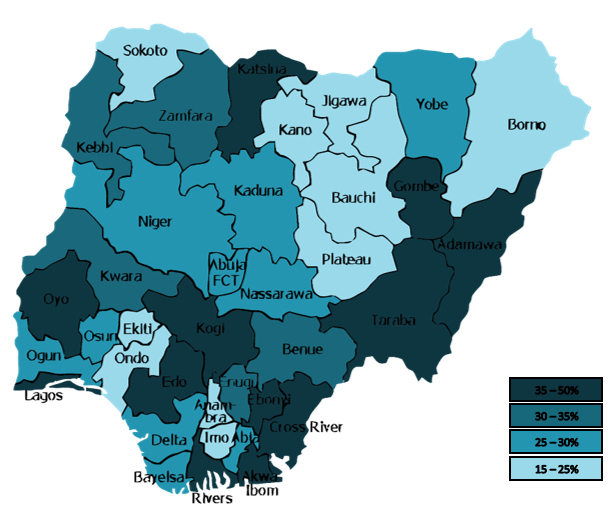
More than half of bribes paid are for personal or family reasons, while only a quarter are for business reasons.
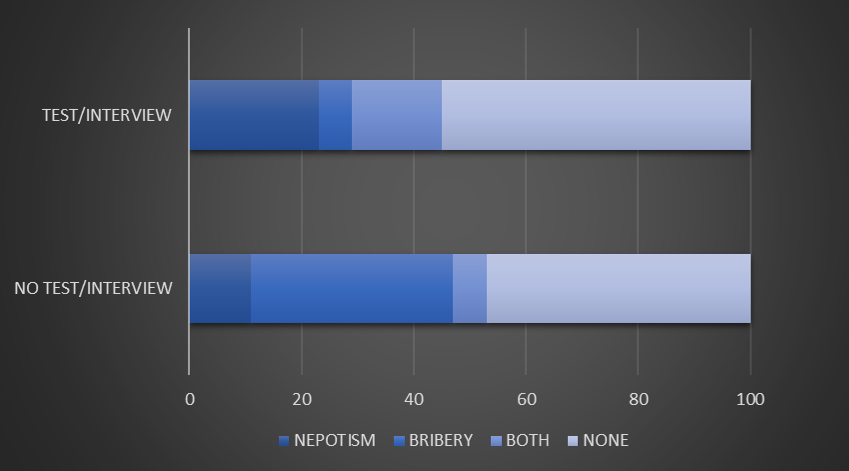
Almost one third (32.5%) of people who secured a job in the public sector in the last three years admitted that they paid a bribe, either personally (16.4%) or through a member of their household (16.1%), to facilitate their recruitment.
More than half (53%) of the people who got public jobs without any tests or interviews admit to having paid a bribe, had nepotism involved or both. Whereas less than half (45%) of people who had to do some sort of tests or interviews before getting the public jobs they have, admit to having paid a bribe, had nepotism involved or both.
In Nigeria, the vast majority of bribery requests are made in the form of a direct request by a public official. Direct bribery requests by public officials accounted for 60% of all bribery transactions in 2019.

There is also a consistent trend in the timing of bribe payments in Nigeria. According to the survey, two-thirds of bribes (67%) are paid before a service is provided by a public official, the remaining are paid after the service (15%), same time as the service (11%) or in two separate instalments before and after the service (2%). The consistently large share of bribes paid in anticipation of a service to be rendered by a public official is an indication that bribes are routinely expected and are prepared for in advance by bribe-payers.

The combination of how bribes are instigated and the timing of bribe payments reveals some very interesting patterns. For example, between 55% and 77% of bribes are paid before the service in question is provided whenever a public official requests a bribe, whether directly or indirectly. This finding underlines the bargaining power of public officials, whose position enables them to solicit payment in exchange for the promise of providing a public service. However, a significant number of bribes are paid before the provision of a service in order to incentivize officials to either expedite service or to avoid red tape. The majority of people who pay unsolicited bribes purely as a sign of appreciation do so after a service has been provided.
The finding implies that there may be a familiar and established routine relating to when payments should be made depending on the nature of the request and the service to be provided. The fact that unsolicited bribes are also paid as a sign of gratitude (mostly after or partly after a service) indicates that some officials in the Nigerian administration expect to receive an “extra” when providing a service that it is their duty to provide for free.

The Police force leads with the highest number of bribes received in 2019, with approximately 33% of meetings with police officers ending up in a payment of some sort of bribe. It is closely followed by the Land registry department and the tax department with 26% and 25% accordingly.

According to the survey, the average cash bribe paid in Nigeria is 5,754 Nigerian Naira (NGN), a sum equivalent to roughly $52 in Purchasing Power Parity (PPP). As a reference, the average monthly income in Nigeria in 2018 was NGN 47,783 ($434 PPP). As bribe payers paid an average of six bribes over the course of one year, it can be estimated that they spent an average of NGN 34,524 ($312 PPP) – equivalent to 6% of the average annual income of Nigerians.
Taking into account that a total of roughly 117 million bribes were paid in 2019, an average bribe size of NGN 5,754 means that a total of around NGN 675 billion was paid in cash bribes to public officials in Nigeria that year, corresponding to 0.52% of the entire Gross Domestic Product (GDP) of Nigeria.
While the private sector is substantially less corrupt than the public sector, it is not entirely rid of bribery and corruption in Nigeria. Up to 7.7% of private officials receive bribes in a particular geopolitical region, while the region with the lowest prevalence of bribery sees approximately 3.8% of officials receive bribes.

Bribery and corruption in Nigeria will not be complete without making mention of the electoral crime of vote-buying. According to the data gotten from the survey, 21% of the adult population of Nigeria reported that they were personally offered money or favour in exchange for their vote in the last national or state election, that is approximately 22.5 million Nigerians.
In conclusion, corruption needs to be tackled first if we want to fix a lot in of problems in our different sectors in this country. But how can the corrupt stop being corrupt? Are we in a fix?
THE MAKING OF A MAD MAN EPISODE 4 – BRIBERY AND CORRUPTION IN NIGERIA
One Comments