
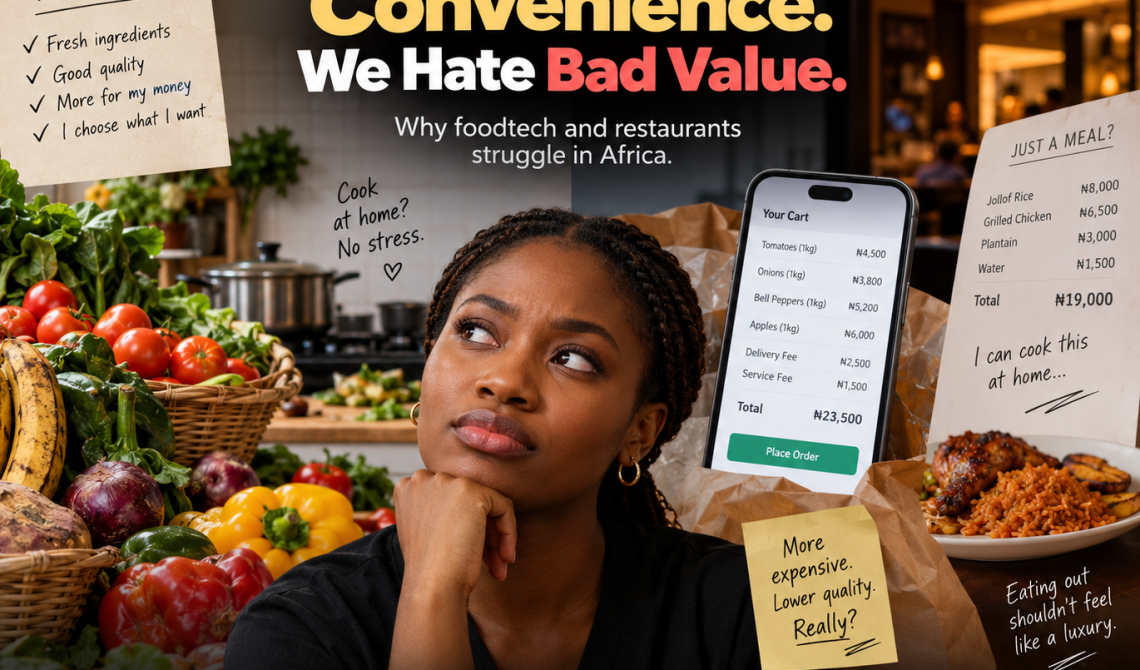
I saw a post recently listing startups that have shut down in Africa over the last few years.
What caught my attention was how many of them were in food.
And I have a theory about why.
I don’t think Africans don’t want convenience.
I think we don’t want to pay a premium for bad convenience.
Take groceries.
If I normally spend ₦100,000 buying good-quality foodstuff myself, and you offer to do it for ₦120,000, I can understand that.
I’m paying you ₦20,000 to save me the time, stress and transport involved in doing the shopping myself.
Fair enough.
But if I order ₦100,000 worth of groceries and:
- I get less than I would normally buy;
- the prices are inflated;
- some of the fruits are already going bad;
- I have to complain about missing or poor-quality items;
- and I still pay delivery and service fees…
Why exactly am I using your service?
I’ve personally had this experience ordering fruits online.
The fruits were more expensive than what I would have paid myself, and some of them were practically spoiled.
I could have gone to the market myself, picked better fruits, paid less and probably still got home before my order arrived.
That experience teaches me one thing:
“I should just do this myself.”
And I think this extends beyond food delivery.
Look at restaurants.
I’m not talking about fine dining. I’m talking about ordinary restaurants where you’re just trying to get a decent plate of food.
Why does eating out sometimes feel like a luxury?
There seems to be an underlying attitude of:
“You can cook this at home. Why are you paying someone else to make it?”
And because eating out is treated as a luxury, the price doesn’t necessarily have to make sense as an everyday service.
You’re not just paying for food.
You’re paying for the fact that you didn’t cook it yourself.
I think this is connected to how we view domestic work generally.
In many African households, feeding the family is still strongly associated with the home, and particularly with women’s responsibility.
So outsourcing it can be viewed as laziness, unnecessary spending or something you only do when you have “made it.”
And when an entire culture thinks about convenience that way, it changes the market.
Instead of asking:
“How can I make this service affordable enough that people use it every week?”
the mindset can become:
“If you can afford not to do it yourself, you can afford to pay more.”
That’s a very different proposition.
And I think it’s one reason our convenience businesses can struggle to achieve mass adoption.
Because the customer isn’t just comparing your price with another restaurant or delivery service.
They’re comparing your price with doing it themselves.
So you have to make the difference worth it.
If I can get ₦100k worth of good groceries myself and you can give me the same quality for ₦120k, I’ll seriously consider paying you.
If you can give me a good meal for a reasonable premium and save me an hour of cooking, I might order regularly.
But if your service is significantly more expensive AND the quality is worse?
I’ll cook.
I’ll shop.
I’ll wash the dishes.
And I’ll tell my friends to do the same.
This is why I find the foodtech conversation in Africa so interesting.
There are obviously serious structural problems: logistics, fuel costs, inflation, fragmented supply chains, purchasing power and difficult unit economics.
But I also think there is a cultural problem around how we value convenience.
In some markets, eating out, ordering groceries or paying someone to clean your home is simply part of how people manage their time.
It isn’t necessarily seen as a luxury.
And perhaps that’s the shift we need.
Because convenience isn’t supposed to be a reward for being rich.
Convenience is supposed to make people more productive.
If outsourcing dinner gives me two extra hours to work, rest, spend with my loved ones or build something, that has value.
If ordering groceries means I don’t spend half my Saturday in traffic and the market, that has value.
But for this model to work at scale, the businesses also have to respect that value.
Don’t charge me like you’re doing me a favour.
Give me good quality. Give me fair pricing. Give me reliability.
Make me feel like I got something worth more than the money I spent.
Because I don’t think Africans hate convenience.
I think we’re just very good at asking: “Why should I pay this much for something I can do myself?”
And until foodtech and restaurants can answer that question convincingly, mass adoption will remain difficult.
We don’t hate convenience.
We hate bad value.