
I recently came across a website called Any Human Ever, and I absolutely loved it.
You can read the story of a random person who lived at some point in human history. Sometimes it’s someone who lived a few decades ago. Sometimes it’s someone who lived thousands of years ago.
I love reading people’s stories, so naturally, I went down the rabbit hole.
And what I found beautiful was seeing how much humanity has changed.
How people lived.
How they travelled.
How they worked.
How they formed families.
What they believed.
What they worried about.
What they considered a good life.
We’re still fundamentally human, but the world we live in is almost unrecognisable compared to the world of someone who lived thousands of years ago.
And somehow, while reading all these stories, my brain ended up here:
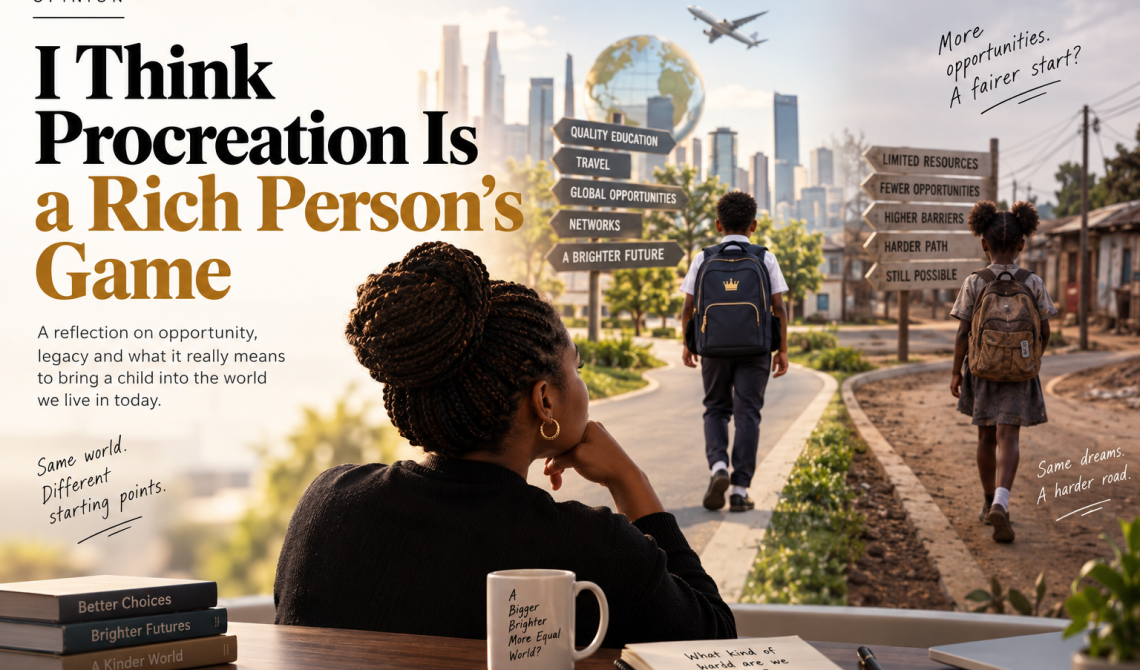
I think procreation is becoming a rich person’s game.
Not because I think poor people shouldn’t have children.
But because I think we’ve reached a point where having the means to give a child a reasonable chance at life should be part of deciding whether you’re ready to have one.
And I think this is partly because the world we are bringing children into has changed.
Life has never been equal
One of the things that struck me while reading these stories is that life has never been fair.
You can find two children born around the same time and their stories can be completely different.
One might die before their first birthday.
Another might live into their thirties, which, depending on the period, could already have been considered a long life.
One might be born into a powerful family.
Another into poverty.
One might have access to food.
Another might experience famine.
One might have a community that protects them.
Another might be completely alone.
So I’m not under any illusion that inequality is new.
Human life has always been unequal.
But something has changed.
We know more now.
And we can do more now.
The world has become bigger
For most of human history, your world was largely your village, your town or your community.
Today, a child born in Lagos can grow up wanting to work in London.
Or Toronto.
Or Nairobi.
Or Dubai.
They can learn from someone in India.
Work for a company in America.
Build a business serving customers in Europe.
Travel across continents.
The possibilities are enormous.
But possibility isn’t the same thing as access.
You can technically go almost anywhere, but you need money.
You can technically study almost anywhere, but you need money.
You can technically work anywhere in the world, but you need skills, access and sometimes the right person to notice you.
And this is where money has become much more powerful than simply being able to buy things.
Money buys options.
It buys the ability to try something and fail.
It buys a better school.
It buys a laptop.
It buys extra lessons.
It buys exposure.
It buys travel.
It buys time.
And sometimes, it buys a phone call to the right person.
Your child’s starting point matters
This is where the idea of having children becomes an economic question for me.
Imagine two children born in the same year.
One grows up with good healthcare, a stable home, good education, a laptop, access to the internet, extracurricular activities, travel and parents who have useful networks.
The other grows up in a household where the parents are struggling to provide food and basic education.
Both children have exactly one life.
Neither chose their circumstances.
But from the moment they are born, the range of possibilities available to them is already different.
And we know this.
We know that nutrition matters.
We know that education matters.
We know that childhood experiences matter.
We know that poverty can limit opportunity.
We know that social networks matter.
We know that money can give people opportunities that others simply don’t have.
So when we knowingly bring a child into the world without the means to give them a reasonable starting point, I don’t think we can completely separate that decision from the disadvantage they may experience.
The child didn’t choose it.
We did.
And then there’s the idea of legacy
I think this is another reason people have children.
Legacy.
“I want my name to continue.”
“I want to leave something behind.”
“My children are my legacy.”
But here’s the strange thing about history:
A thousand years from now, your legacy probably won’t be your children.
Unless you’re incredibly powerful, wealthy, famous or historically significant, nobody is going to know the names of your great-great-great-great grandchildren.
And even if they do exist, their connection to you will probably be a footnote.
But your story?
That can survive.
Think about the people we still talk about today.
We talk about what they did.
What they created.
What they changed.
What they believed.
What they discovered.
What they fought for.
What they contributed.
We don’t spend most of our time talking about their children.
Even the people we consider legendary aren’t remembered because they reproduced
Take Christianity.
Jesus is at the centre of one of the world’s largest religions, and he is traditionally understood as having had no biological children.
Yet his legacy is enormous.
Not because he left descendants.
Because of what he did during his lifetime.
And look at the women whose stories have survived through history and scripture.
Deborah.
Esther.
Their stories are still told thousands of years later because of what they did and the roles they played.
Their legacy isn’t dependent on us knowing the names of their children.
Then there are historical figures like Cleopatra.
She had children. Her children were real people with their own stories and political significance.
But when most people hear “Cleopatra,” they don’t immediately think about her children.
They think about Cleopatra.
Her power.
Her intelligence.
Her politics.
Her relationships.
Her role in history.
Her story.
And that’s the point I’m getting at.
Having children is not the only way to leave something behind.
If legacy is what you want, build a legacy
If your biggest reason for having children is that you want to live on through them, I actually think there are other things you could do.
Write.
Document your life.
Build something.
Teach.
Create.
Invent.
Mentor people.
Help your community.
Be excellent at what you do.
Be kind.
Be influential.
Make someone’s life significantly better.
Build something that outlives you.
Tell your story so that, 500 or 1,000 years from now, someone can stumble across it and think:
“Oh. This person lived.”
That’s essentially what I was doing on Any Human Ever.
I wasn’t looking for the descendants of people who lived thousands of years ago.
I was looking at their lives.
Their decisions.
Their experiences.
Their worlds.
Someone, somewhere, decided that their story was worth preserving.
And now I get to read it thousands of years later.
That’s a different kind of legacy.
Which brings me back to children
I’m not against having children.
Quite the opposite.
I think bringing another human being into the world is one of the biggest decisions a person can make.
And that’s precisely why I think we should take it more seriously.
Humanity has evolved.
We live longer.
We understand more.
We have more choices.
We know more about what shapes a person’s life.
We know how much education matters.
We know how much nutrition matters.
We know how much environment matters.
We know how much money and networks can influence opportunity.
And we are raising children in a world that is bigger, more connected and, in many ways, more competitive than the one our ancestors knew.
So I don’t think “I want children” is enough of a reason anymore.
I think we should also be asking:
Can I give this person a reasonable chance at the life I’m bringing them into?
Not a perfect life.
Not a rich life.
Not a life without hardship.
Just a reasonable chance.
Because if I already know that a child’s starting point matters, and I knowingly create a situation where they will be severely disadvantaged, I don’t think I can pretend that the outcome is entirely out of my hands.
They didn’t choose their starting line.
I chose it for them.
Maybe this is what evolution looks like
Humanity keeps evolving.
Our relationships have evolved.
Marriage has evolved.
Work has evolved.
Family structures have evolved.
Technology has evolved.
Our understanding of childhood has evolved.
Our understanding of health and wellbeing has evolved.
So perhaps our ideas about having children should evolve too.
For a very long time, having children was simply part of being human.
And it still is.
But perhaps we’re now at a point where responsible procreation requires more thought than simply whether we want to be parents.
Maybe it requires asking whether we have the resources, stability and capacity to give another human being a fair starting point.
And if legacy is what we’re really looking for, perhaps we should stop assuming that our legacy has to carry our DNA.
Your legacy can be your work.
Your ideas.
Your kindness.
Your inventions.
Your writing.
The people you helped.
The things you changed.
The stories you left behind.
A thousand years from now, your descendants may not remember your name.
But someone might find something you created and discover that you existed.
And honestly, I think that’s beautiful.
So yes.
After happily reading the stories of random humans who lived thousands of years ago, my brain somehow arrived at this:
I think procreation is becoming a rich person’s game.
Not because rich people deserve children more.
Not because poor people can’t raise wonderful human beings.
But because we now know enough about life to understand that bringing someone into the world is also deciding the circumstances from which they will have to begin.
And I think that responsibility deserves to be taken seriously.